
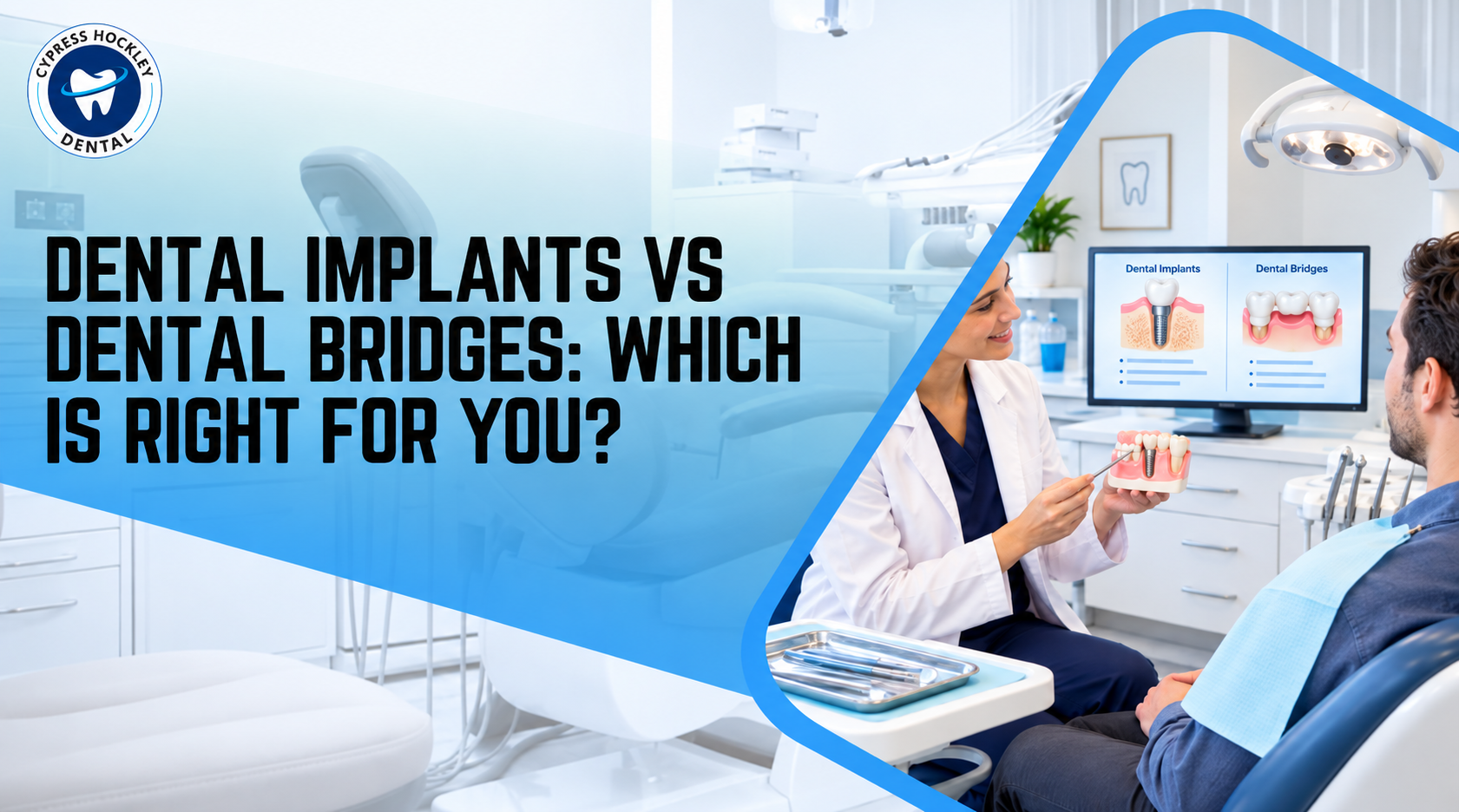
Replacing a missing tooth is about more than improving your smile. It can also affect how you chew, speak and care for your remaining teeth. If you are comparing dental implants vs dental bridges, you may be wondering which option offers the right balance of appearance, comfort, durability, treatment time and cost.
Both dental implants and dental bridges are established tooth replacement options but they work in different ways. An implant is placed into the jawbone and can support a crown, while a bridge replaces a missing tooth or teeth by using neighboring teeth or other supporting structures. According to the American Dental Association (ADA), these restorations can be used to replace missing teeth.
What Are Dental Implants?
Dental implants are tooth replacement structures that provide stable support for restorations. An implant is placed into the jawbone and allowed to integrate with the surrounding bone before a crown is attached. Unlike bridges, implants can provide independent support for a replacement tooth.
How Do Dental Implants Work?
The process generally involves:
- Consultation and planning – The dentist evaluates your oral health, missing teeth and treatment needs.
- Implant placement – The implant is surgically placed into the jawbone.
- Healing and integration – The implant is allowed time to heal and integrate with the surrounding bone.
- Restoration – A custom crown or other restoration is attached to complete the tooth replacement.
The exact treatment process and timeline can vary depending on the number of missing teeth, bone support, oral health and individual treatment needs.
What Are Dental Bridges?
Dental bridges are fixed restorations used to replace one or more missing teeth. They use neighboring teeth or other supporting structures to hold the replacement tooth in place, helping restore your smile, chewing and everyday oral function.
How Do Dental Bridges Work?
The process generally involves:
- Consultation and planning – The dentist examines the missing-tooth area and surrounding teeth.
- Preparing the supporting teeth – The neighboring teeth may be prepared to support the bridge.
- Creating the bridge – A custom bridge is designed to fit the patient’s mouth and match the surrounding teeth.
- Placing the bridge – The finished restoration is securely attached to complete the tooth replacement.
The exact process can vary depending on the number of missing teeth, the condition of the supporting teeth and the type of bridge selected.
What Is the Difference Between Dental Implants and Bridges?
When comparing dental implants vs dental bridges, the key distinction is their design. An implant replaces the missing tooth’s root with a fixture in the jawbone, while a bridge fills the gap using a connected restoration supported by nearby teeth or other structures.
| Factor | Dental Implants | Dental Bridges |
| Primary support | Jawbone | Adjacent teeth or supporting structures |
| Structure | Implant with a crown or restoration | Replacement tooth connected to a bridge |
| Effect on nearby teeth | Usually independent | May involve supporting teeth |
| Bone requirements | Adequate bone support is important | Does not require implant placement in the jawbone |
| Treatment stages | Often involves multiple stages | Typically involves fewer stages |
| Healing | Requires healing after implant placement | Generally no implant-healing period |
| Cleaning | Regular brushing and specialized implant care | Brushing and cleaning around and beneath the bridge |
| Best suited to | Patients with suitable bone and oral health | Patients with suitable supporting teeth and oral health |
Your dentist may consider the missing tooth’s location, surrounding teeth and gums, bone support, treatment timeline and preferences when discussing dental work bridge vs implants to determine the most suitable restoration.
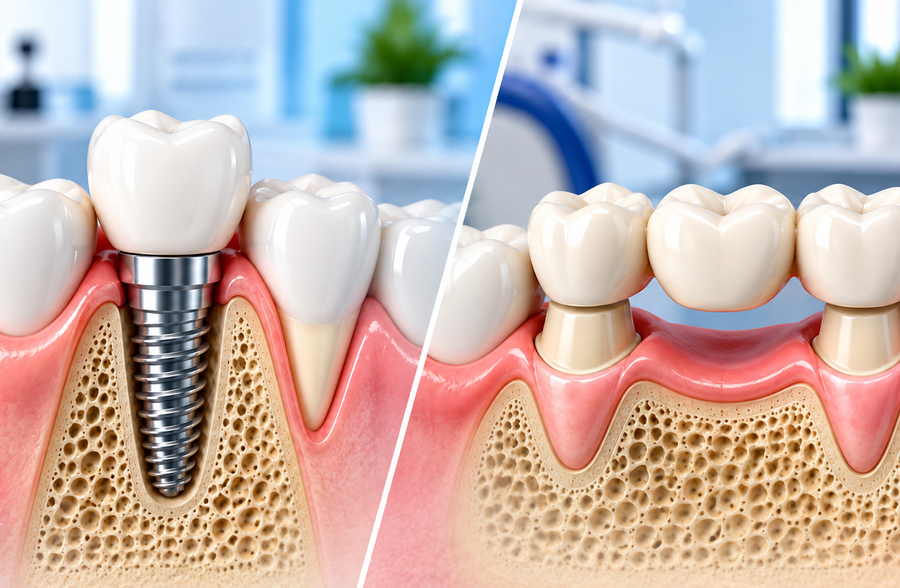
Dental Implants vs Dental Bridges: Pros and Cons
Understanding the pros and cons of dental implants vs bridges can help you compare these tooth replacement options and prepare for a more informed discussion with your dentist.
Benefits of Dental Implants
Dental implants provide a stable foundation for replacement teeth and can be used to replace a single tooth or multiple missing teeth.
- Independent support: Does not rely on neighboring teeth.
- Natural appearance: Designed to look like natural teeth.
- Stable fit: Provides secure tooth replacement.
- Better function: Supports chewing and speaking.
- Durable option: Can provide long-lasting results with proper care.
Limitations of Dental Implants
Dental implants require careful evaluation and may not be suitable for every patient or situation.
- Surgical procedure: Requires implant placement.
- Healing period: Needs time for bone integration.
- Bone and gum health: Suitable support is important.
- Higher initial cost: May cost more than some bridges.
- Additional treatment: Some patients may need preparatory procedures.
The choice between an implant and a bridge depends on factors such as your oral health, bone support, surrounding teeth and individual treatment needs when considering is an implant better than a bridge.
Benefits of Dental Bridges
Dental bridges can replace missing teeth without placing an implant into the jawbone. They may be suitable when healthy supporting teeth or structures are available.
- Fixed option: Stays securely in place.
- No implant surgery: Does not require implant placement.
- Replaces missing teeth: Can replace one or more teeth.
- Fewer treatment stages: May require a shorter process.
- Restores function: Supports chewing, speaking and smile appearance.
Limitations of Dental Bridges
Dental bridges also have considerations that should be discussed before treatment, particularly regarding the teeth or structures supporting the restoration.
- Supporting teeth: Must be strong enough to support the bridge.
- Tooth preparation: May require preparing nearby teeth.
- Cleaning: Requires careful cleaning around and underneath.
- No root replacement: Does not replace the missing tooth root.
- Maintenance: May need repair or replacement over time.
Understanding these dental bridges and implants options can help you discuss your needs with a dentist and determine which restoration may be appropriate for your oral health.
Which Is Better: Dental Implants vs Dental Bridges?
When comparing dental implants vs dental bridges, there is no single option that suits every patient. Factors such as missing teeth, gum health, jawbone support, surrounding teeth, treatment timeline, and personal treatment needs can influence the choice.
Key factors to consider include:
- Oral health: Healthy gums and supporting tissues are important for both options.
- Bone support: Adequate jawbone support may be needed for an implant.
- Neighboring teeth: The condition of nearby teeth can influence whether a bridge is suitable.
- Treatment timeline: Implants may involve healing, while bridges may require fewer treatment stages.
- Long-term care: Both options require good oral hygiene and regular dental checkups.
- Treatment goals: Your preferences for appearance, function, comfort and maintenance also matter.
The choice between dental implants versus bridges should be based on your individual dental condition rather than cost alone. A dental evaluation can help identify the appropriate tooth replacement option for your needs.
Dental Bridge vs Implant for Front Teeth
When comparing dental bridge vs implant for front teeth, factors such as smile appearance, gum health, bone support and neighboring teeth can influence the treatment choice.
Both options can restore a missing front tooth but the appropriate solution depends on your oral condition and individual restoration needs.
About Cypress Hockley Dental
Cypress Hockley Dental provides personalized dental care in Cypress Hockley, TX, with services including dental implants, dental bridges, dentures, preventive care and restorative treatments. The practice focuses on comfortable, patient-centered care and personalized treatment planning based on individual oral health needs.
Why Choose Cypress Hockley Dental for Dental Implants or Bridges?
Choosing the right dental clinic is an important part of your dental restoration. Cypress Hockley Dental focuses on personalized care and treatment planning for patients considering different tooth replacement options.
- Personalized treatment plans: Options are tailored to your oral health, needs and treatment goals.
- Dental implants and bridges: Patients can discuss both dental implants and dental bridges based on their specific situation.
- Modern technology: Digital imaging and advanced diagnostic tools support accurate treatment planning.
- Comfort-focused care: The team emphasizes patient comfort throughout the treatment process.
- Comprehensive dental care: Additional restorative and preventive services are available under one roof.
- Transparent care: Treatment options, expected steps and costs can be discussed before proceeding.
If you are comparing dental implants vs dental bridges, a consultation at Cypress Hockley Dental can help you understand the available tooth replacement options for your needs.
Ready to Explore Your Tooth Replacement Options?
Not sure whether dental implants or dental bridges are right for you? Schedule a consultation with Cypress Hockley Dental to discuss your missing tooth oral health, treatment goals and available restoration options. The team can help you understand the differences between each treatment and plan the next step for your smile.
Contact Information
Cypress Hockley Dental
Address: 27160 US-290, Suite 206, Cypress, TX 77433
Phone: +1 (832) 345-1669, (832) 532-6537
Email: info@cypresshockleydental.com
Conclusion: Choosing the Right Option for Dental Implants vs Dental Bridges
Choosing between dental implants vs dental bridges involves more than comparing prices. Both can replace missing teeth but they differ in how they are supported, how treatment is performed and what factors should be considered before treatment.
Cypress Hockley Dental can help you understand how dental implants and dental bridges may fit your individual oral health needs. Gum health, bone support, neighboring teeth, treatment timeline, budget and personal goals can all influence the decision. If you are still wondering what is better a bridge or implant, a consultation at Cypress Hockley Dental can help you discuss your available tooth replacement options and determine the next step for your smile.
“A healthier smile starts with the right replacement—choose what fits your smile, not just the space.”
FAQs – Dental Implants vs Dental Bridges: Which Is Right for You?
Q1. What is the difference between dental implants and bridges?
Ans. Dental implants are placed into the jawbone and can support a replacement tooth, while dental bridges replace missing teeth using neighboring teeth or other supporting structures.
Q2. Is it better to have a dental implant or a bridge?
Ans. Neither option is automatically better for everyone. Dental implants vs dental bridges depends on factors such as bone support, gum health, surrounding teeth, treatment goals, timeline and budget.
Q3. Are dental implants better than bridges?
Ans. Dental implants can provide independent support for a replacement tooth, while dental bridges can offer a fixed replacement without implant surgery. The suitable option depends on your individual dental needs.
Q4. Which is more painful, bridge or implant?
Ans. An implant involves surgery and may cause temporary soreness or swelling during healing. A bridge generally does not involve implant surgery, although supporting teeth may experience temporary sensitivity.
Q5. How do dental implants work?
Ans. Dental implants are placed into the jawbone and allowed to integrate with the bone before a restoration is attached. The process generally involves consultation, implant placement, healing and restoration.